Advertisement
“Being undocumented during my formative years … meant that I always lived with fear,” recalls Alberto Ledesma. “I thought that any misstep I took could endanger [my] entire family.” An artist and writer, Ledesma is one of the approximately 2.7 million formerly undocumented immigrants who were able to adjust their status because of the Immigration Reform and Control Act (IRCA) of 1986. His 2017 graphic memoir, Diary of a Reluctant Dreamer: Undocumented Vignettes from a Pre-American Life, recounts growing up undocumented in East Oakland in the 1970s and ’80s.
Forty years after IRCA, the experience of living in constant fear of being disappeared or having a loved one disappeared, of seeing one’s family torn apart, endures for many immigrants and their families in the United States. In addition to increasing border security and penalizing employers for hiring undocumented workers, IRCA allowed millions of undocumented immigrants to “wipe the slate clean” by regularizing. So, “why is it that we have not heard more stories about their experiences?” Ledesma asks. His answer: “Though amnesty made it easy for a generation of undocumented immigrants to come out of the shadows, it did not remove the cultural taboo that still exists in our communities regarding that experience.”
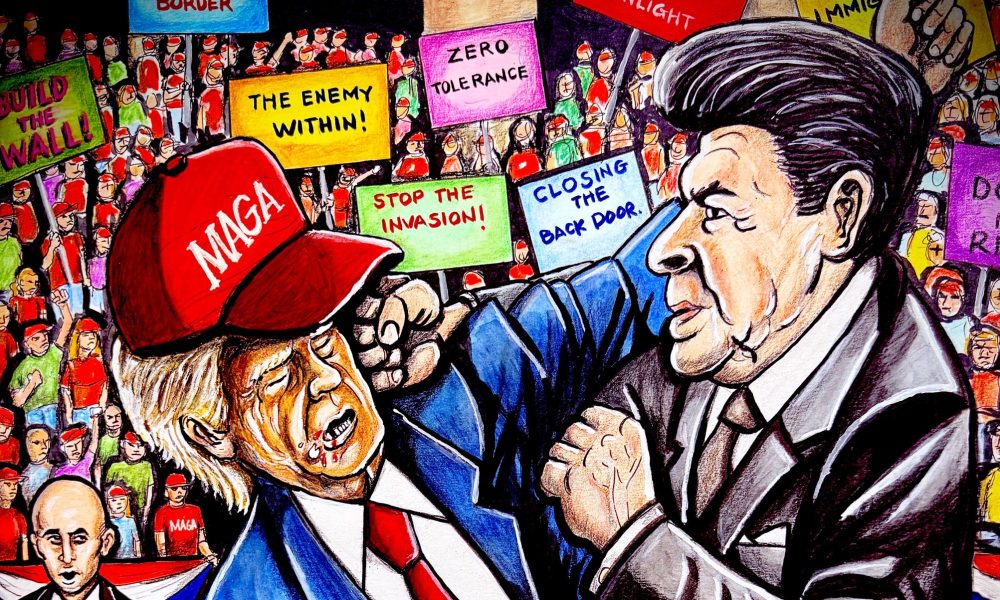
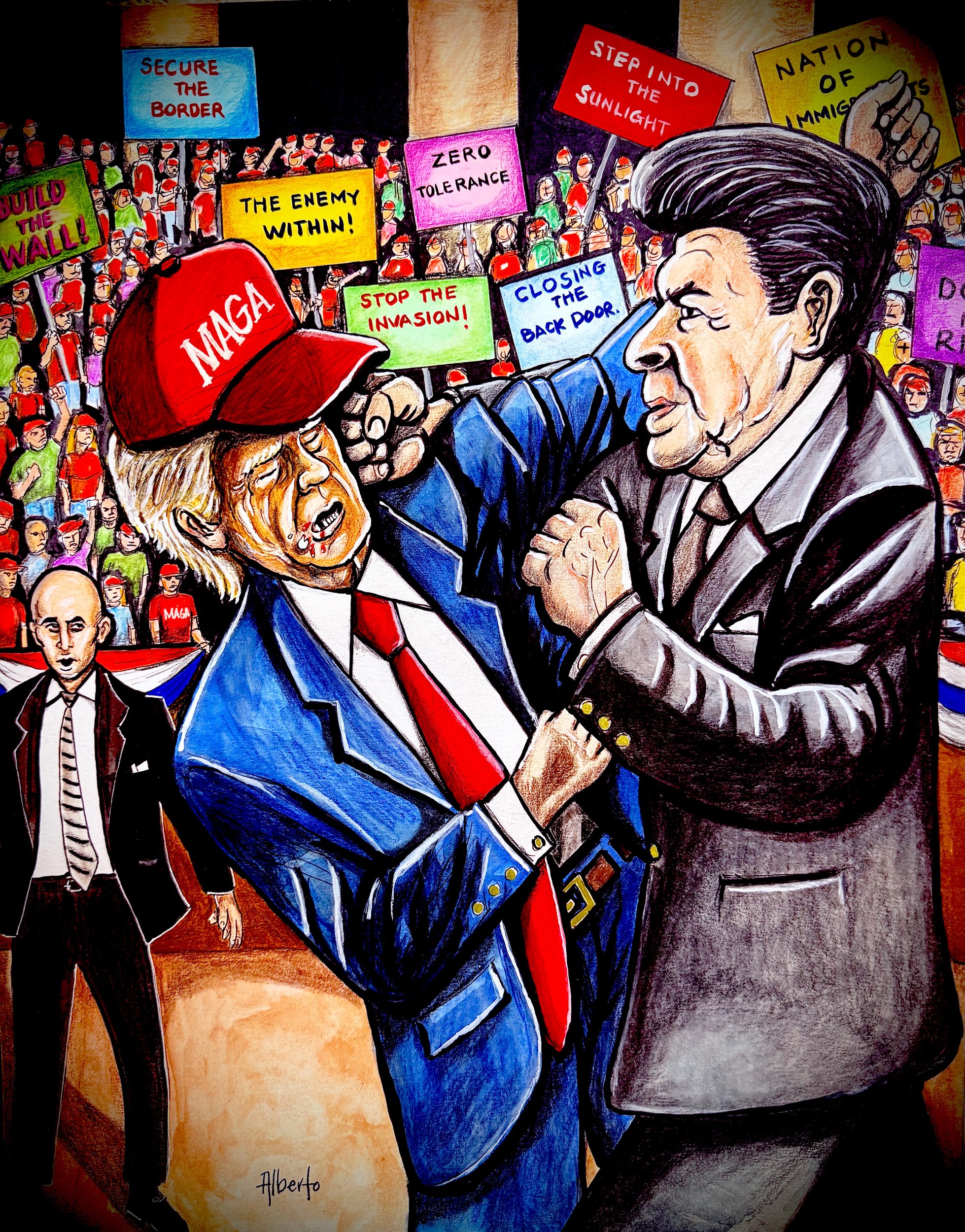
That experience—of fear, stress, and shame because of illegality—has metastasized today. This is why Ledesma’s illustration, Republicans Debate Amnesty (2025), confronts IRCA’s legacy.
In this illustration, Donald Trump and Ronald Reagan duke it out in a ring, surrounded by spectators holding signs emblazoned with axioms from US immigration debates. Some of those axioms—such as Build the Wall, Secure the Border, and The Enemy Within!—come from the Trump regime, while others—like Step into the Sunlight and Closing the Back Door—hark back to IRCA. Looking more than a little like Nosferatu, Stephen Miller lurks in the background. “Generally, what I am meaning to evoke are the hypocritical slogans and policies that Republicans / white Christian Nationalists deploy when their aim is to manipulate the American population—mostly their own communities—by strategically scapegoating immigrants,” Ledesma says about his illustration. “The intra- and inter-manipulative messaging becomes so confusing that it, in and of itself, fuels the vitriol.”
Vitriol is an engine of MAGA. Chaos is a consequence. With its cacophony and color, Republicans Debate Amnesty evokes that vitriol and chaos. The illustration also nods to UFC Freedom 250, the mixed martial arts competition produced by Ultimate Fighting Championship that’s scheduled to take place on the South Lawn of the White House in June 2026, allegedly to commemorate the 250th anniversary of the United States.
An MMA competition on the White House’s South Lawn is certainly unprecedented. However, as Walter Benjamin warned in the 1930s, “Fascism sees its salvation in giving the masses not their right,” nor a change to the capitalist status quo, “but instead a chance to express themselves.”1 In other words, fascists offer the people spectacle in lieu of real social change. From this perspective, UFC Freedom 250, like illegality and the exploitation, terror, and misery it spawns, isn’t so unprecedented after all. But neither is amnesty.
Artwork by Alberto Ledesma
Text by Catherine S. Ramírez 
This article was commissioned by A. Naomi Paik and Catherine S. Ramírez.
- Walter Benjamin, “The Work of Art in the Age of Mechanical Reproduction.” In Illuminations: Essays and Reflections, 241. Translated by Harry Zohn (Schocken, 1968). ↩