
Being reviewed:
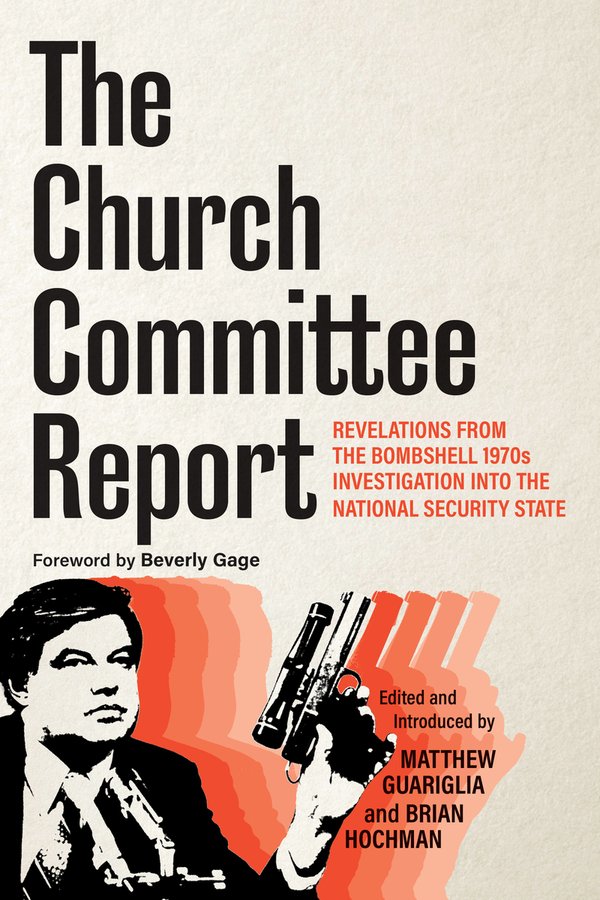
The Church Committee Report: Revelations from the Bombshell 1970s Investigation into the National Security State
Advertisement
This April marked the 50th anniversary of the release of the Church Committee Report, a sweeping investigation into abuses by the US intelligence community during the Cold War. Here, I discuss repression, government spying, and the state of the surveillance state with Matthew Guariglia and Brian Hochman, coeditors of The Church Committee Report: Revelations from the Bombshell 1970s Investigation into the National Security State.
Matthew Guariglia is a historian and senior policy analyst at the Electronic Frontier Foundation. His first book, Police and the Empire City, explores the history of race, ethnicity, and policing in New York City from the Civil War to World War II. Brian Hochman is the Hubert J. Cloke Director of American Studies and Professor of American Studies and English at Georgetown University. His most recent work, The Listeners, recounts the history of wiretapping in the United States, covering everything from Prohibition-era spying to counterterrorism.
Morgan Barry (MB): For starters, tell me a little bit about your research and how you came to develop this new edition of the Church Committee Report.
Matthew Guariglia (MG): My first book (Police and the Empire City) was about how demographic shifts between the Civil War and the 1930s changed policing in New York City. And specifically, I was interested in how the police department at an institutional level reckoned with race, ethnicity, and linguistic differences. I argue that beat cops became the people who learned on behalf of the state, that as they were the ones entrenched in urban communities, they developed a knowledge base about the relationship between ethnicity and criminality that then became departmental policy.
Their work or ideas of criminality were predicated upon a lot of stereotype and pseudo-scientific understandings of race and crime. And this has become a larger project for me, thinking about how the state learns about people and how the knowledge the state creates through surveillance is flawed or becomes actionable.
For that reason, I’ve always kind of been obsessed with the Church Committee Report. I’ve been thinking about it for a long time. I first read it after the NSA leaks of 2013. The report shocked me then, and I’m still shocked now by how relevant it is. Ever since, I have wanted to do a project around the Church Committee Report.

BH: Matt and I, interestingly, we’ve lived parallel lives, and they finally intersected around the publication of my last book,The Listeners. I’m a cultural historian, and most of my work has focused on the politics of technology and media, but we share extremely similar historiographical interests and dispositions. In my work on the history of wiretapping—which dates all the way back to the origins of the telegraph in the 19th century—I had encountered the Church Committee Report as this critical resource for a history of electronic surveillance from the perspective of the state. It became critical in my understanding of the history of wiretapping and of the history of surveillance.
After my book came out, Matt proposed this idea of developing a new edition of the Church Committee Report. We both agreed that it probably deserves a more thoroughgoing treatment than it has received thus far. We also felt it deserves a much wider audience than it has, especially beyond academic historians of surveillance, of politics and social movements. And now the 50th anniversary is upon us.
MB: For those who don’t know, what was the Church Committee investigation? What was happening in the 1970s that prompted the inquiry?
MG: The Church Committee Report came out of a series of scandals and shocking revelations going back several years to things like the Pentagon Papers, which was a data breach that revealed that the Department of Defense had been lying to the American people about certain aspects of the war in Vietnam, as well as the 1971 revelation of COINTELPRO, which was the FBI’s extensive surveillance and sabotage apparatus aimed at “neutralizing” mostly left-wing political activists. The Watergate Scandal also played a role, as well as the kind of culminating issue, which was the exposure of the CIA’s mass domestic spying apparatus against anti-war protesters in the Vietnam War era (also known as Operation CHAOS).
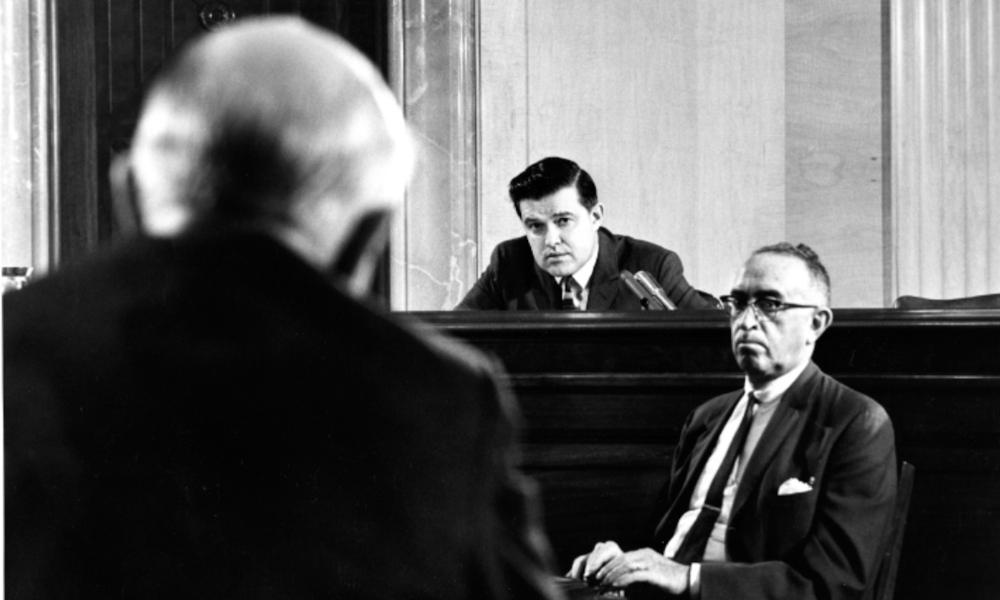
All of this culminated in multiple investigations by the White House, the House of Representatives, and the Senate, but the most thorough and successful of the three becomes the Church Committee investigation, headed by Frank Church, a Democratic senator from Idaho.
MB: Who were some of the major figures involved in the investigation?
BH: Frank Church is obviously the leading figure here. However, his name and his reputation and his penchant for showmanship, often overshadowed the contributions of other political figures who were a part of the committee, most notably Walter Mondale, future vice president who was then a senator from Minnesota. He led the investigation into the arena of domestic intelligence, while Church was in charge of investigating surveillance in the foreign arena. Church the individual also somewhat overshadowed what was really a sprawling and well-organized staff, which did the lion’s share of the investigative work.
Another figure to know is the chief counsel of the Church Committee, Frederick A.O. Schwarz, Jr. (scion of the FAO Schwarz toy fortune). He was a well-known New York attorney who was associated with several progressive political causes, a kind of fellow traveler of the American Civil Liberties Union. Schwarz, after he was named chief counsel, really shaped the inner workings of the committee and its investigative purview in critical ways. The Committee’s interest in particularly sensational abuses—from the CIA’s experiments on non-volunteer human subjects to the FBI’s surveillance and harassment of Martin Luther King Jr.—were really a product of Schwarz’s theory of political attention. He wanted to shock the nation into political change. Whether he was successful in this, it’s tough to say. But the Church Committee investigation was certainly a passion project for him.
MB: What do you see as some of the most important revelations to come out of the Church Committee investigation?
MG: The big revelations included the system of illegal surveillance of people engaged in First Amendment activities. Also, the fact that there was a systematized network of sabotage, blackmail, and breaking and entering. These affected the entire spectrum of left-wing movements in the US. A lot of the attention has also been on the CIA’s experimentation with chemicals, be they poisons or the MKUltra Program, in which the CIA experimented with mood-changing or so-called brainwashing drugs. People tend to remember their experimentation on nonvolunteer human subjects, the large global system of assassination attempts, and their assistance of certain factions in foreign countries to institute regime change.
Some things that don’t get enough attention but are important lessons of the Church Committee Report—and that are especially useful today—is the picture it paints of a government in which all information the government collects is ripe for use by the punitive arms of the state. The state’s ready use of, for instance, tax information collected by the IRS. People’s tax info was subject to surveillance and blackmail by the FBI, and that doesn’t get talked about enough when it comes to the Church Committee Report.
Everything from the surveillance and harassment of Martin Luther King Jr. to the CIA’s mind control experiments … all of these stories are a product of the Church Committee and its moment.
BH: When I’ve been talking about our work with colleagues and friends over the last few years, many will say they don’t know anything about the Church Committee specifically, but they often do know about the worst abuses of intelligence power during the Cold War, and that comes as a result of the Church Committee, whether people realize it or not. Everything from the surveillance and harassment of Martin Luther King Jr. to the CIA’s mind control experiments, to the NSA’s partnerships with global telecommunications firms, to the attempts to assassinate foreign leaders like Patrice Lumumba, Fidel Castro, and Rafael Trujillo—all of these stories are a product of the Church Committee and its moment.
But one of the things to add here is that the term “revelation” may be the wrong way to describe the Committee’s findings. As much as the Committee structured its investigation and the report around a core set of “revelations,” for many Americans, particularly those who were the objects of the state’s illegal activities in the 1960s, the exposure of these programs wasn’t a revelation, but corroboration. It was confirmation of a story about state power that existed as a kind of folk belief or animating principle among political organizers and social activists. This was just the first time that this story received the imprimatur of the federal government.
Most left-wing activists and civil rights activists knew on some level that their telephones might be tapped, that newcomers to political organizing might be informants. It’s just not really until the Church Committee holds its hearings in 1975 and produces its report in 1976 that that conspiratorial idea gets confirmed and is made part of the official record.
I realize that my saying this runs counter to the subtitle of our new edition of the Church Committee Report, “Revelations from the Bombshell 1970s Investigation into the National Security State.” But I’m not quite sure that “revelation” is exactly the way to think about it.
MB: Absolutely. To some people these were revelations, but to others, the investigations just confirmed their own experiences and vindicated the things that they had been saying for years, but that others had cast aside as mere “paranoia.”
BH: There’s also an important generational understanding that we need to take into account when we think about the Church Committee and its effects. For younger Americans, those who affiliated with the New Left and came of age amidst civil rights and anti-war protests, the state’s ability to do harm was far more palpable, intelligible, and visible. But to their parents’ generation—many of whom came of age during World War II and the New Deal years—there was far greater trust in the state.
Many Church Committee staffers have reflected on this and remember this quite clearly. Senator Philip Hart, who was originally tapped to lead the Church Committee but had to beg it off because he was undergoing chemotherapy, testified to this during one of the hearings. This is a senator, a critical figure in the Democratic Party in the 1960s, and his children had constantly told him that the FBI was surveilling social movements, that Martin Luther King Jr. was being targeted. But he disregarded their story. He told them that they were crazy, that they were paranoid. Then, in a very memorable set of hearings, he admits that he had for years dismissed the possibility of such abuses, and yet here they are. He essentially apologized to his children for not believing that the intelligence bureaucracy was capable of this level of unethical, and in some cases, illegal activity.
So, the Church Committee hearings and report were revelatory to many Americans, but for others, particularly younger people who were involved with progressive social movements, it was more like confirmation or corroboration rather than revelation. It was a mass feeling of like, “Okay. I wasn’t wrong. This did happen to me.”
MB: Upon its release in April 1976, the Church Committee Report concluded with nearly a hundred recommendations related to privacy rights and greater government accountability. Which did lawmakers take up and why? Which were never implemented?
MG: The ones that were implemented, it’s a much shorter list. What you have is a few mechanisms for oversight. You have the creation of the Permanent Senate Intelligence Committee and the rule that it needs to be briefed on intelligence operations. This is one of the most significant outcomes. Just over a year later, you also have the passage of the Foreign Intelligence Surveillance Act (FISA) and the creation of the Foreign Intelligence Surveillance Court (FISC). This creates a system in which a judge presides over secret hearings on whether or not the government can do intelligence collection, sometimes on a very large scale, as part of its counterintelligence operations overseas. This is another lasting impact.
Whether or not these are actually effective at creating oversight is another matter, though. More recent history post-9/11 proves that these mechanisms did not do a good job being anything other than a rubber stamp for the intelligence community. Had half of the Church Committee’s recommendations come to pass, things might be very different now. There were a lot of recommendations that would have altered society for the better and would have maybe even quashed a lot of the problems we’re facing now. And much earlier on, in their predigital format.
BH: There are startling and even harrowing ways that the Committee’s recommendations resonate in the contemporary moment. There’s a whole subset of recommendations surrounding the US Military’s or the intelligence community’s assassination capabilities on foreign soil. The Church Committee, in no uncertain terms, wanted to eliminate that capability and enshrine a ban on foreign assassinations into law. That doesn’t happen. The Ford administration presents an informal assassination ban, but it never becomes law.
What we’re seeing now in our newsfeed—whether it’s the attempt to decapitate the Iranian government or whatever the military is doing to suspected drug smugglers overseas—I doubt that we would be encountering such things today had the Church Committee’s recommendation to eliminate foreign assassinations been taken up.
MB: So, along those same lines, what similarities do you see between the surveillance state of the 1960s and 1970s and the surveillance state of today?
MG: Technology obviously has played a major role in that it is much easier to collect a tremendous amount of personal information on people than it was back then. A lot of the rubber-stamping that has been done at a legal level, especially in the post-9/11 period, has not just enabled surveillance of a few people based on their First Amendment-protected activities, but the surveillance of millions. The USA PATRIOT Act unleashed a great deal, much of which we learned about in the 2010s with the WikiLeaks Scandal and the Snowden Disclosures.
But it is a problem that continues to exist into our current moment. We see this right now with practically every branch of the intelligence community and domestic law enforcement buying geolocation data on people from data brokers en masse. These are hundreds of millions of digital devices, whose geolocation is sometimes being taken several times an hour, available on the open web, and the government is just buying it. No doubt it’s unconstitutional, but there is a legal loophole that the government is exploiting to do so.
Basically, one of the key continuities is the myth that the government doesn’t surveil people because of their political beliefs or their relationship to activism. There has never been a moment, going all the way back to the creation of the Bureau of Investigation, that this has been true, that the government doesn’t spy on people because of their politics. Despite what the law says, the government still spies on people because of their political beliefs. What is new is the scale to which the government can collect data very, very easily. And now with AI, they don’t even need the legions of employees or the aircraft hangers in Virginia that they used to have to store and process the information they collect.
BH: The scale has changed, certainly, but the playbook has remained virtually the same. Still it’s: surveil, infiltrate, discredit. This has been the government’s modus operandi vis-à-vis social movements who are working to change the status quo since before J. Edgar Hoover. The government’s toolbox is actually quite small, and while certainly those tools have transformed over time, and capabilities have transformed over time, the general uses of those tools remain virtually consistent across history.
This is one reason why reading the Church Committee Report today is so compelling and also so terrifying. Despite all that it revealed or corroborated, fifty years later, not much has changed at all.
The Church Committee Report offers possibly the most detailed and fullest account of the problems that come with an expanded, almost untrammeled conception of executive power. And we live today in a moment in which the executive is acting like a rogue elephant, to use Frank Church’s famous metaphor. If there’s ever another Church Committee, however many years from now, I expect we’ll be hearing about many of the same problems as those of the 1970s.
MB: Setting these many continuities aside, what were some of the major impacts or consequences of the Church Committee Report? And what makes it still so relevant today?
MG: The lasting impact is really the report itself. It is the knowledge of what the government is capable of and that it has a deep history of breaking the law to undermine political movements in the United States. This is mostly common knowledge now, and that is probably the most important and lasting impact of the Church Committee investigations.
BH: Certainly, we can debate whether the committee was a success or a failure in terms of its effects on policy or the culture of the Washington intelligence establishment. Historians and policy analysts have debated this for fifty years. Perhaps it was a legislative failure and there were far more missed opportunities than successes, but one shouldn’t think about the Church Committee and its legacy solely in those narrow terms.
In terms of historiography, for example, it was a resounding success. The Church Committee and the subsequent investigations that it spawned in the Senate and the House in the latter half of the 1970s have provided a critical resource for historians and surveillance studies scholars. Walter Mondale, who headed the domestic investigation, recognized that in interviews much later in his life. He believed that that was the most important effect of the Church Committee: that it changed public knowledge and historical understanding of this dimension of state power.
One thing that we’re seeing now under the second Trump administration is a remarkable boldness…
MB: So even though subsequent administrations have undone many of the protections that came out of the 1970s privacy rights movement, no one could ever take back the knowledge that that moment produced. And perhaps the American public has never seen the government or the surveillance state the same way.
MG: Right. And since the Church Committee, there’s been an attempt by the government to not break the law per se, but to change the laws or to interpret the laws creatively so that what they want to do falls within technical legality. But one thing that we’re seeing now under the second Trump administration is a remarkable boldness. Unlike in the years after the Church Committee, the government is not really trying to find ways of sugarcoating or justifying its actions. It’s much more willing than ever to just ignore the law altogether, and to say as much.
The Church Committee Report stated that “there is no inherent constitutional authority for the president or any other intelligence agency to violate the law.” Basically, the US intelligence community has broken the law for as long as it has existed, but what’s shifted right now is the relationship between the White House and the intelligence community to the law. Before there was at least some lip service, some attempt to conceal what the intelligence community was doing. Now this is no longer being done.
Of course, laws are permission structures, and you can interpret them as creatively as possible. Everybody has their interpretations about why the thing I think is illegal is legal. But the Trump administration isn’t even doing that intellectual work.
BH: Yes. A real discontinuity between surveillance during the Kennedy administration, the Johnson administration, and the Nixon administration is that there was at least a conservative attempt by agencies like the FBI, the CIA, and the NSA to do all of this stuff in the dark. But one of the disorienting realities that we face today is how deeply the state seems to want to do the unethical, even the illegal, right out in the open. And in fact, this is central to the political brand of the Trump administration, to just say the quiet part out loud, as the saying goes.
MB: Almost like surveillance and countersubversive policing were much more decorous back then.
My last question is: What do you hope readers will gain by revisiting the Church Committee Report? And what are some of the problems you hope a new edition will help address?
MG: Hopefully, the fact that as unassailable as the intelligence community tradition and secrecy was until the 1970s, eventually the pendulum swung back. I hope it serves as a reminder that the good ol’ boys club that sustained the violation of civil liberties for decades, eventually its shell did crack.
And one of the things that took it down was a bipartisan commission willing to follow the facts no matter what administration’s legacy got besmirched. I see the Church Committee as providing a valuable playbook for how we can do a wide-reaching, very deep bipartisan congressional investigation into decades-long abuse of civil rights and civil liberties, regardless of what administration authorized them. 
This article was commissioned by Ben Platt.