
Being reviewed:
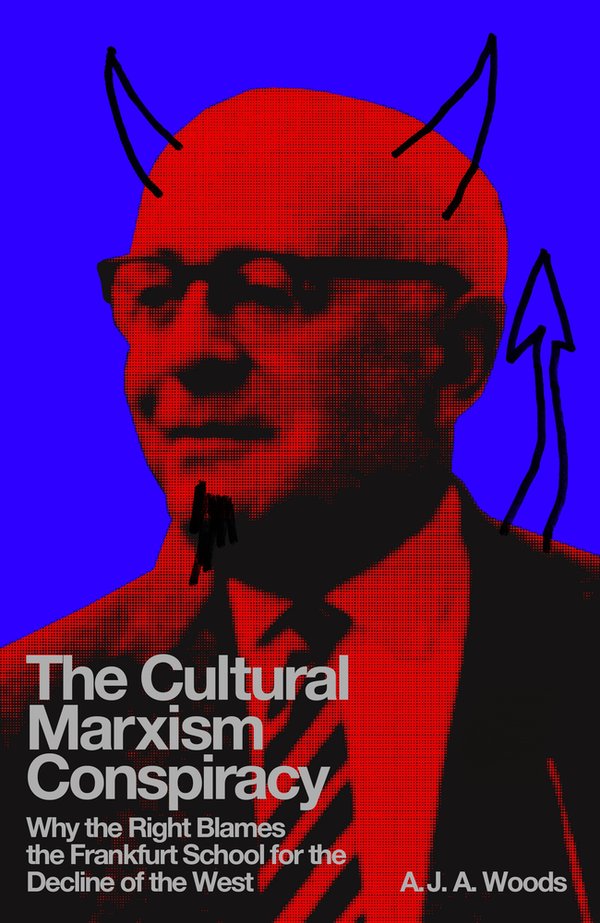
The Cultural Marxism Conspiracy: Why the Right Blames the Frankfurt School for the Decline of the West
Advertisement
Once, many elements of life—relations between sexes and races, the economy and structure of the family and household, acceptable sexuality, codes around personal comportment—were treated as “natural” social behavior by much of official culture. Yet in the 1960s and ’70s, waves of protest movements—whatever their failings—succeeded in taking such elements out of the natural realm, and making them political. This opened the possibility for previously marginalized groups of people to make systemic change, while existentially threatening most forms of right-wing politics. And so, in the decades since, the right’s task has been to marshal the forces of the state and society to police the newly politicized social realm.
For this policing to succeed, the right had to sell an idea: that nobody in the streets during the ’60s (or thereafter, unless they were right-wingers) had a legitimate grievance. There was no inequality or injustice worth protesting. But this raises an obvious follow-up question: If people had no problems, why, then, did anyone demand change? Why did they work hard enough to make change happen? Versions of this question crop up often in the history of conservatism: If things were so great before, why and how did things change?
How the right answers this question is, typically, “Because a sneaky group of bad actors wanted to do us in.” Throughout the history of conservatism, the identity of the bad actors has varied across different contexts; very often, and in many of the most crucial situations, the right has identified either specific Jews or the Jewish community as a whole. When they aren’t specifically Jews, then the right’s bad actors who brought about the fallen world—Communists, intellectuals, secret societies—often take on the attributes of European stereotypes of Jews, to the point that they are barely distinguishable.
Given the structural role racism plays in modern thought (by no means just on the right), white people by and large would not credit people of color with the intellectual ability to effectively subvert their institutions. But in the reactionary worldview, an evil counterpart to the people who should rule—themselves—could do such a thing. If Jews didn’t exist, the right would need to invent them, to act as the snake in the garden.
The latest in this history—of the right creating Jewish boogeymen to act as a source of subversion—is something they call “cultural Marxism.” The broad strokes of the cultural Marxism narrative goes like this: Before the onset of the Second World War, a group of German Marxist intellectuals associated with Frankfurt’s Institute for Social Research—almost all of them Jews—fled Nazi Germany, came to the United States, and reassessed their approach to revolution. Rather than overthrow capitalism with a worker’s uprising, these members of the “Frankfurt School” decided to overthrow the United States in another way: by subverting American values through cultural change. Intellectuals like Theodor Adorno and Herbert Marcuse wooed students at elite universities, who, in turn, spread their subversive ideas through education, entertainment, government, even much of the corporate world, and beyond. This “cultural Marxism” has rendered Americans confused and demoralized, easy pickings for supposed Marxist tyrants like Barack Obama.


Over the last 30 years, the “cultural Marxism” conspiracy theory has metastasized into a party line for the global right. Casting most social change since the mid-20th century as the result of a plot by devious intellectuals—most notably the leading lights of the Frankfurt School—to undermine Western civilization and bring about Communist totalitarianism, the conspiracy theory is the answer to everything / scapegoating mechanism par excellence for resurgent fascism.
For believers, this narrative explains everything that has happened in politics and culture since at least the 1960s. It ties matters of the highest importance—the survival of freedom and civilization—to all the petty cultural grievances believers have into one seamless story, with the plot of a paperback thriller.
British intellectual historian A. J. A. Woods has taken on the task of writing an intellectual history of this conspiracy theory. Their new book, The Cultural Marxism Conspiracy, serves as a strong first entry in getting a handle on this phenomenon, and even more critically, using it as a means to understand the contemporary right. Woods takes great pains to approach the topic with the rigor that is missing both in the cultural Marxism conspiracy theory itself and in most mainstream accounts of it. This rigor mostly serves them and the reader well but has some strange lacunae regarding the theory’s antecedents and the centrality of antisemitism in it.
MAGA can’t be a fascist movement, some argue, because fascism is counterrevolutionary, and there had been no revolution recently for the right to counter. Alas, no one can convince the right that a revolution has not taken place, is still taking place, that the left is not omnipotent and omnipresent. To Woods, as to most leftist critics, “political correctness,” critical race theory, the welfare state (back when that existed), are, at best, well-meant half-measures. At worst, these are efforts to prevent a revolution against capitalism by ameliorating some of the system’s worst effects and incorporating potentially revolutionary movements for liberation into the mainstream.
But the right sees all of this—and, in particular, the parts of it that generate scary images of Black militants, gay and trans people, and so on on their TV or phone screens—as a highly successful revolution that America, Christianity, capitalism, and freedom has barely survived. And so, the contemporary right pursues its war against “cultural Marxism” with a counterrevolutionary fervor similar to that of reactionaries who faced real, indisputable, successful revolutions.
Among other things, The Cultural Marxism Conspiracy stands as a splendid example of how to do intellectual history of what would, once, have been considered sub-intellectual.
This presents a problem for the mainstream of intellectual history. The discipline takes seriously the history of canonical texts and philosophical movements; it traces the history of ideas that, however bad or even horrific they might be, had some pretense of rigor and internal consistency. But the right’s campaigns of the 21st century challenge the discipline’s own rigor and methodologies. Because while Nazism was built out of lies, “cultural Marxism” is based not just on lies, but on solecisms, mistakes, category errors. Movements like Nazism were hardly free from embarrassing errors, either, but they attracted enough serious intellectuals as supporters to provide leverage for intellectual history as usually practiced. This is not the case with cultural Marxism conspiracy theory (with most conspiracy theory, and many other important ideas). Thus, the mainstream of intellectual history is not especially well-equipped for the task of writing the history of this idea.
Among other things, The Cultural Marxism Conspiracy stands as a splendid example of how to do intellectual history of what would, once, have been considered sub-intellectual. Woods deftly characterizes the range of actors in the four sites of production of the conspiracy theory he highlights in this history. They show a keen eye for the intellectual history of opportunism, fanaticism, and the charged space between the two. We benefit from the fruits of their strong archival work through the dank depositories of LaRouchean thought, old think tanks, and the ephemeral archives left by rapidly iterating, heavily online movements. The writing is strong and lively throughout.
Woods tells the story in four parts. We begin in the weird world of Lyndon LaRouche, an ex-Trotskyist crank who formed a strange political cult around himself starting in the ’70s and only ending with his death in 2019. LaRouche and his followers lived in a small, isolated world of paranoia, pseudo-philosophical elitism, and strange schemes that would periodically surface into public view. Anyone who has encountered the image of Barack Obama with a Hitler mustache has seen a work of LaRouchean agitprop. In a way that will be familiar to anyone who’s spent time with conspiracy theorists, LaRouchean obsessions combined elements of global drama—supposed conspiracies of bankers, cultists, and the British royal family to depopulate the world—with the trivial, like the leader’s preferences in classical music. In keeping with this, some of LaRouche’s followers coined the phrase “cultural Marxism” to describe the popularity of the Beatles and the rise of “political correctness,” which they saw as parts of a conspiracy to degrade the objectively superior culture associated with classical music (and with LaRouche’s opinions).
We then encounter William Lind, Paul Weyrich, and other think-tank intellectuals of the Christian right in the 1990s, who fleshed out the narrative of a Jewish-Marxist plot against specifically American/Western values and introduced it to the American right. This took place during the lee tide of the Reagan revolution. As an economic and political agenda, Reaganism had won so definitively that the Democrats had taken up much of its deregulatory free trade agenda. But 12 years of Republican rule had delivered much less for social conservatives, and starting in 1993 they faced rule by a libertine draft dodger and his career woman wife. In these doldrums, think tankers backed by right-wing fortunes (Koch, Coors, etc.) put a sheen of respectability on John Birch Society–style paranoid conspiracy theory to help define their enemy in a situation where the culture as a whole seemed to be turning against them.
The next stop is the Tea Party, which expanded the cultural Marxism conspiracy theory into a worldview. Little paid attention to today, the Tea Party was MAGA before MAGA, a right-wing insurgency within the Republican Party activated by the 2008 economic meltdown and fear of the first Black president. More than successfully driving the Republicans farther into the fever swamps of the right (aborting a feeble effort to moderate some of the party’s stances to win over Obama voters), the Tea Party helped promote new styles and methodologies of right-wing politics in the US. This moment saw an effort to create media and educational institutions to counter the supposedly cultural Marxist ones they see as dominating mainstream culture, where the likes of Andrew Breitbart and Steve Bannon gained national prominence.
Lastly, we see what cultural Marxism conspiracy theory in power looks like in the 2020s, as a now-global reactionary right that takes the theory as gospel truth undertakes a series of “woke scares” and sets the stage for more efforts to eliminate all opposition to its counterrevolution. Pseudo-intellectuals like James Lindsay and Chris Rufo use the conspiracy theory as a theory of history and politics. They define their enemy through the anti-cultural-Marxism framework, which also informs their strategy in driving authoritarian culture war measures through legislatures across the country. Globally, the right in Britain, Brazil, Hungary, and elsewhere have also taken up cultural Marxism conspiracy theory as both explanation, rallying cry, and cudgel.
Among the themes in the book, what stands out is Woods’s concept of the “counter-politicization of the social.” This is an admirably clear and capacious way to describe the universe of fear and loathing that animates the cultural Marxism conspiracy theory. The American right found itself in the late 20th century presented with a range of spaces opened up to political dispute: domestic arrangements, sexuality, racial hierarchy, personal comportment as regards all of these things, American exceptionalism, etc. The first preference of the right would have been for these areas of life to be considered natural, prepolitical. But, as the European right found out two centuries ago when they tried and failed to put an end to mass politics and bring back the authority that the old monarchies had before the French Revolution, there really isn’t any returning to the past. The right’s genius has been to find ways to use political dynamics opened up by the left for the purposes of enshrining and protecting arbitrary authority and hierarchy.
The right has found numerous ways to successfully counter the politicization of social life that leftists and marginalized groups have used to democratize society and improve the lives of the people, from financialization and austerity to mass incarceration. Cultural Marxism is an artifact of the frustration that even after decades of rollback, marginalized people and those of us who will organize for a better world have not gone away. One of the reasons that cultural Marxism has taken hold as an explanatory theory is that it serves multiple pressing needs for the American (and increasingly global) right. It expresses the frustration inherent in even successful efforts to staunch people’s freedom to seek progress. It gives a unifying program to those pursuing various strategies of counter-politicization, from transphobic bathroom legislation to mass deportation to DOGE. And above all, it provides a villain, the snake in the garden any conservative theory needs to explain why society abandoned the allegedly self-evidently virtuous and strong hierarchies and traditions of the past in the first place. It locates these villains in the traditional place, too: It’s the Jews.
Woods does not deny the antisemitic element in the cultural Marxism theory and discusses the ways in which it smuggles antisemitism into a culture that is supposed to be officially opposed to it. They do make some strange judgment calls in The Cultural Marxism Conspiracy that act to obscure the theory’s place in a longer history of reaction and antisemitism. These judgments appear to be tied in with intellectual influences that Woods otherwise puts to good use.
Italian Communist philosopher Antonio Gramsci strongly influences Woods’s work (Gramsci also plays a role in the conspiracy theory lore). Gramsci developed the concept of the “conjuncture.” Roughly, a conjuncture is a crisis in the socioeconomic system, which various actors try to steer to create a new order. Woods uses the concept of the conjuncture to define the circumstances in which the cultural Marxism conspiracy theory developed and spread. They define this conjuncture as the long, global ’60s, which ushered in the aforementioned politicization of the social. Cultural Marxism is impossible to understand outside of this conjuncture, they tell us.
This rigorous materialism, supposedly, drives Woods to cursorily dismiss the similarities between the cultural Marxism theory and Kulturbolschewismus, the “cultural Bolshevism” concept important in early 20th-century fascism. The logic, here, is that the phrase “cultural Marxism” seldom appears in right-wing writing until the 1990s, with a long gap between then and the end of World War II. We must follow the lines of intellectual transmission, they tell us, and in the end, the hard proof is in shared nomenclature. To do otherwise would be unrigorous. They go so far as to insist that we must “ignore” the parallels and similarities between cultural Marxism and Kulturbolschewismus.
On its own, the boundary Woods draws could be consistent, if debatable. But if the standard of what belongs in this story is a direct line of transmission, defined by use of the phrase “Cultural Marxism,” Woods does not apply a consistent standard. The line of transmission between the LaRouche concept of cultural Marxism and the one Lind, Weyrich, and other ’90s conservatives made into a cudgel and theory of history, is extremely tenuous. A colleague of Lind’s might have read the Fidelio article. This colleague also wrote about political correctness and the Frankfurt School in an edited collection in which Lind’s work also appeared.
Per Woods:
It seems that Lind first heard about the Frankfurt School from his friend Raymond V. Raehn, who allegedly borrowed material from Minnicino’s 1992 Fidelio article to produce an unpublished manuscript entitled “Critical Theory: A Special Research Report.”
There are no citations in the advanced review copy sent me by the publisher for this passage. We do not know who is doing the alleging here. Woods informs us that Raehn’s report is now lost.
It’s possible that Lind borrowed the phrase “cultural Marxism” from a fellow think tanker who read it in a LaRouche cultist’s essay, perhaps in a LaRouchean magazine lying around at the FCF office- we know from Woods that the LaRouche cult sent issues of Fidelio to think tank libraries, unsolicited. But Woods does not present us with proof. Woods gives us no more reason to think that Lind got the idea from the LaRouche magazine than that Lind coined it independently or adapted it from “cultural Bolshevism.”
Is the link between the LaRouche cult and Republican think tankers so much stronger than that between today’s cultural Marxism and the “cultural Bolshevism” of the Nazis?
Even if we can prove that Lind was influenced by the LaRouche essay, how much would that mean? Is the link between the LaRouche cult and Republican think tankers so much stronger than that between today’s cultural Marxism and the “cultural Bolshevism” of the Nazis? It’s true, the LaRoucheans and subsequent right-wingers used the same “cultural Marxism” verbal construction. Is lexical similarity a stronger indicator of historical relation than, say, similarity in ideas, imagery, and aims, like that between the cultural Marxism theory and the Kulturbolschewismus theory?
The best, most generous explanation for the choice Woods makes lies elsewhere in their definition of the conjuncture. The backlash to the long ’60s and spiraling wealth inequality that defines the American scene in the late 20th and early 21st centuries is, indeed, not the same as the dynamics that gave rise to theories of Kulturbolschewismus. That being said, if there is room for the LaRoucheans—a profoundly marginal group of people with esoteric concerns—in our explanatory framework, partially due to a highly tenuous link to others in the space, an instruction to “ignore” the longer history of ideas similar to cultural Marxism is hard to swallow. This is especially the case as those who embrace the cultural Marxism conspiracy theory promote antisemitism ever more openly. It points to a lack of confidence in the tools of materialist, Marxist history to take on a deeper understanding of the role ideas play in the historical process.
There’s another possible explanation for Woods’s odd lacuna here. Perhaps Woods didn’t write about Nazism and antisemitism because the similarities between Kulturbolschewismus and cultural Marxism seem obvious and, hence, boring. This also would help explain why they start with the LaRouche movement: It’s a novel subject, and a really weird, fascinating one. They really do deserve more historical attention, for solid academic reasons and because they’re so interesting, in their creepy way. Discussions of antisemitism drag writer and reader into one of the most fraught conversations of the day, with a great deal of bad faith on many sides.
It’s unlikely Woods sought to soft-pedal antisemitism. More likely, they sought to make a new path in a discussion that can get stagnant in part by ditching, more stridently than makes sense, aspects of the problem that didn’t interest them. In doing so, they produced a pathbreaking work, if one with some curious gaps explained in ways that don’t quite pass muster. The Cultural Marxism Conspiracy is not the last word on the topic, but it is an innovative and generative starting place.